Showing posts with label Austria. Show all posts

Thursday, 31 July 2014

Innsbruck, Austria - Sophistication in the Alps

After Vienna, I travelled three hours by train to the smaller city of Innsbruck in the Austrian Alps. I enjoyed two melanges on the train, the traditional Viennese coffee that is the regular cup of expresso with a milk foam of sorts poured on top. I had been warned that this was a specifically Viennese drink and would be cut off from it in most other places even within Austria. I went for the second cup and arrived in Innsbruck a bit more jittery and sweaty than normal.

Train-travel sophistication. A cup of melange at 240km/h:


A city of some 120,000 people, Innsbruck is the smallest city since Arras, France I have stayed in - a pleasant change from the big cities of the past few weeks.

The city sits in a very low valley at an altitude of some 500m. The mountain ranges on all sides aren't particularly tall by Canadian Rocky standards, however they have almost twice the prominence (look bigger) than the mountains around Canmore, Alberta because the valley is so much lower. They are quite striking - but often shrouded by cloud.

Think of Innsbruck as much like Canmore, but with no pick-up trucks, no million dollar McMansions and a public transit system that rivals Vancouver:


A problem soon emerges: due to the size of the city, I vastly underestimated the ease of finding a hostel without a reservation. A few tries at ones near the central station were greeted with laughter, not a good sign for the wayward  traveller. I walked nearly 30 minutes to the edge of the city to find a hostel that was full as well. I met two Spainards in the same situation and between the the three of us we convinced the staff to allow us to convert the luggage room into a temporary dorm for a paltry (or expensive depending on how you look at it) 12€ / night. Problem solved!

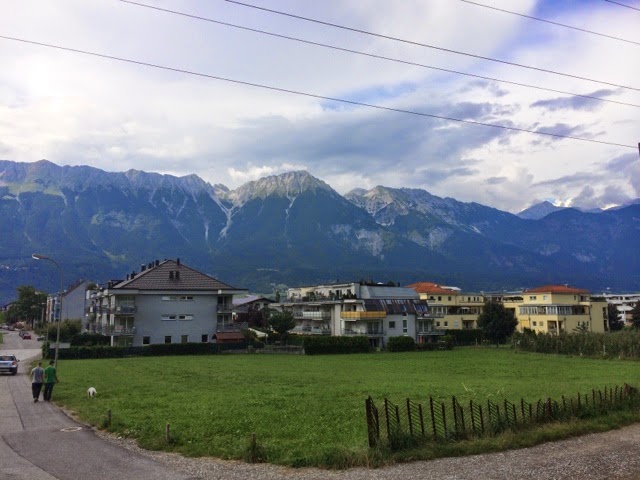
The view from the hostel makes it all worth it:

After a good nights rest - a debatable fact due to being forced to eat dinner with my new Spanish friends at the "regular" 11pm followed by a lengthy argument about which type of bears are the best with some Koreans (hint stop what you are doing and google Korean Bears, they are the best) - I was ready to tackle the mountains the following morning.

This being the Alps, most of my choices allowed easy cable car access to aid my decent. Again, Europe doesn't know how to do anything without sophistication.

I chose to tackle the Hafelekarspitze, a 2,300m mountain to the north highly visible from Innbruck.

Here it is from the bottom. You may just be able to make out a small white chalet three-quarters of the way up the mountain, that is a cable car stop:


Access to the base of the climb is granted from the centre of the city by an underground funicular railway - specially designed to handle steep slopes - that is an impressive work of engineering and architecture for a city the size of Red Deer. Red Deer barely knows what a bike-lane is, let alone a tram and funicular- filled rapid transit utopia like Innsbruck. Perhaps I'll finish slamming Red Deer in a future post.

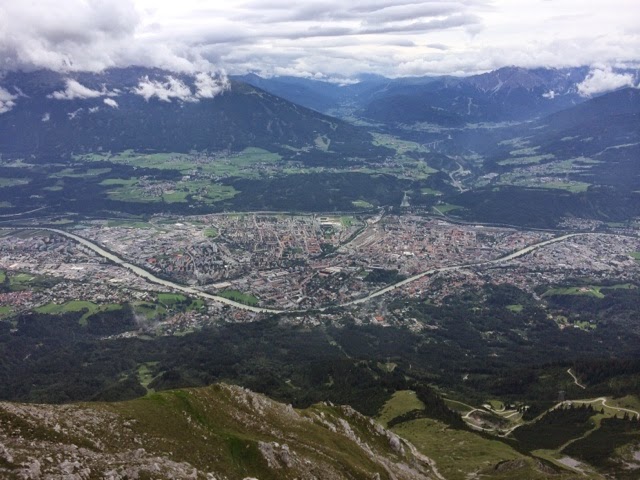
A brisk four hour walk led me to the top just as the clouds and mists parted:


Innsbruck:

To the north:


An excellent coffee at the summit cafe (see sophistication) and I was down by a very expensive cable car ride of 19€. No discount for the 1,400m I climbed to get here unfortunately:


Innsbruck is quite sleepy as one would expect. I used the tram to get around, a brilliant idea in every city. I have seen few that are better setup than Innsbruck's due to it's simplicity.

Take the stations for starters. Simple, effective and cheap. Nothing more than a next stop time display, seats and a ticket machine. The design shares the stop with buses and is the only part of the network that prohibits cars from driving on the tracks:


It's the small details that set it apart. One thing is the off-board ticket machines. 1.60€ for a 90-minute ticket while 2€ if you buy from the driver on-board. It encourages efficiency and makes all but the most clueless tourists buy from the machine instead of the driver, allowing her to continue driving, speeding the journey up dramatically. Think how much faster taking the bus in Calgary would be if everyone could board at any door, and the ticket prices encourage you to buy off the vehicle allowing the driver to proceed to the next stop very quickly instead of hand out transfers. Currently there is no discount of buying off vehicle in Calgary, nor is all door boarding allowed, creating unnecessary long queues to jam into the single door on front and each pay the driver individually. 

The trams are about half the size of a three-car LRT in Calgary, but hold substantially more people than even an articulated bus. The have next stop information displays, live maps and notifications on which side the tram's doors will open at the next station. A view inside the tram:


The 30 minute walk from the central station to the hostel takes 7 minutes on the tram - and the vehicle never exceeds 30 - 40 km/h. It is able to achieve this by using these low cost, efficiency improvements everywhere it can, rather than the traditional and expensive way of separating the transit line from everything else. It is also quiet enough that it runs down narrow residential streets and navigates tight turns of the inner city as easy as any bus, giving it much better access to where people actually live than a station built in a freeway median like many in Calgary.

The tram arrived every 5-10 minutes throughout the day and evening, providing rapid transit to this tiny city. As if that wasn't enough night service is provided. Here is a excerpt from the transit company's website:

"Round-the-clock operations for you:

For all those who are on the move through the night or who have late work shifts, there is an IVB night service. The Nightliner, the ASTI telephone group taxi and the Women’s Nighttime Taxi bring you home quickly, safely and inexpensively, no matter what the hour."


Imagine any transit organization that puts that much effort and focus on individuals of all demographics and needs; not just the regular 9-5 crowd.

Sophistication. In a city the size of Red Deer. Amazing.


Now I won't have to slam Red Deer in a future post. 


Sunday, 27 July 2014

Vienna - A City that Wants You

Vienna - Wien if you're In the German-speaking part of the world - is a spectacular city. It has more monuments, marble and more landmarks than most new countries have combined. Until the Berlin reunification, Vienna was the largest German speaking city in the world of nearly 2 million inhabitants. While it currently has nowhere near the level geo-political prominence in world affairs the city enjoyed in the 17th to 19th centuries, Vienna still impresses with an attitude of greatness; both past and present.

Coming from Munich is around three and a half hours by train, reaching up to 240km/h. Austrian trains are some of the best I have seen so far: clear English and German announcements, a digital map that shows where you are travelling in real-time, and a live speedometer (which is why I can provide the extra tid-bit of information). Smooth and spectacular all the way into Wien Westbahnhof, followed by a 20 minute walk to the old city.

10€ ($15 CAD) and five minutes after walking off the train I had 10GBs of data for my phone. The irony really hits that I am currently paying $75 CAD this past month for 1 GB of data in Canada that I have no way of using. The day of reckoning will come for the Canadian telecom companies and I would love to be there to see it through. Alas, I will not be leading the charge on that fight; I have urban planning and design to rant about.

Back on point: Vienna is spectacular. Here are a few sights you will see in a matter of  minutes from one of the many central plazas and public spaces:

~900 year old St. Stephens Cathedral in central Wien:


Inside:


Hofburg Palace and the adjoining complex of incredible halls and government buildings:


Another:


This 10-metre tall Maria Theresia Statue:


Streets that look like this in every direction:


The kooky, mid-1980s designed Hundertwasser Haus:


The list goes on and on. Connecting all of this the Vienna U-Bahn, the subway system. Trains come all day and 24 hours on weekend nights at a frequency of every five or eight minutes on five lines. Nowhere in the city is more than five minute walk from a metro station and no place is really more than 20 - 30 minutes apart in total travel time using the metro. Signage is perfect, there are system maps on every conceivable surface in the trains, and lines are colour-coded and numbered to avoid any chance of confusion. I could not think of anything that would make the system easier to use. Believe me, I tried!

The train system was also unique in that it attempted to run schedules around what people actually do, as opposed to what would be easier for the transit operator to provide. For example, every Friday and Saturday night is 24-hour rapid transit service because it is the night that most people go out to the thousands of restaurants, clubs and venues crowding the streets of the inner city. There is no nightly transit service in most Canadian cities and many actually reduce the level of service of their transit system on the weekend, even though the demand from revellers and employees of the "night-economy" is at it's highest.

This same approach is used on public holidays where Vienna runs more trains not less. Again the assumption here is that lots of people are going out on the town to celebrate with family and friends and therefore they need a ride home. Vienna is happy to oblige. 

This is indicative of a broader trend in many European cities compared to Canada. There is an assumption that public services like transit and infrastructure are for everyone, not just some idealized version of what people are "supposed" to do. Back in Calgary, Calgary Transit has been successful at catering to the downtown workforce, but have been less successful at catering to the wider community that is not always business hours focused. Quality of transit service is also allowed to be worse for the general public in areas like reliability, wait-times and frequency. Vienna there is no such assumption. The idea is that everyone, in any part of the city, has the right to efficient mobility on public transit. It is not treated as a second-class service to car traffic. 

One more thing on transit: an express train from the airport is billed at taking 16 minutes from there to a central U-Bahn stop. 16 minutes. Ridiculous.

My favourite part of Vienna:
Museum Quarter is a spectacular chain of plazas and walkways that link between a few dozen - I know, only a few dozen? It's like they aren't even trying - museums and cultural institutions from art to dance to music to architecture and more.

A view of in the daytime looking at MUMOK, Vienna's grey, ultra-modern shrine to contemporary art:


The Museum Quarter is billed as one of the largest cultural facilities in the world. It is tied together with thousand of open seats and irregular blue-block street furniture - in the foreground of the picture above. Unlike Calgary, Amsterdam, Berlin and many others places, there is an incredible focus on creating public seating. It is everywhere you look and Wieners use it at all times of the day. Imagine seats lining the CPR underpasses between downtown Calgary and the Beltline neighbourhood. There are countless seats lining every park and path as well as on nearly all sidewalks and side streets. If there is ever a city that wants to encourage people to slow down and linger in it's public spaces, Vienna is it.

Calgary is certainly emulating designing public spaces in this way. The much-beloved Prince's Island Park is covered in benches and picnic sites, grassy knolls for Shakespeare in the Park performances, and rocks to sit and contemplate with the babble of the Bow in your ears. The newest edition to the city centre pathway network, the East Village River Walk builds on these ideas that Vienna does so well, offering benches and lookouts frequently with the high-quality level of design any great city deserves.

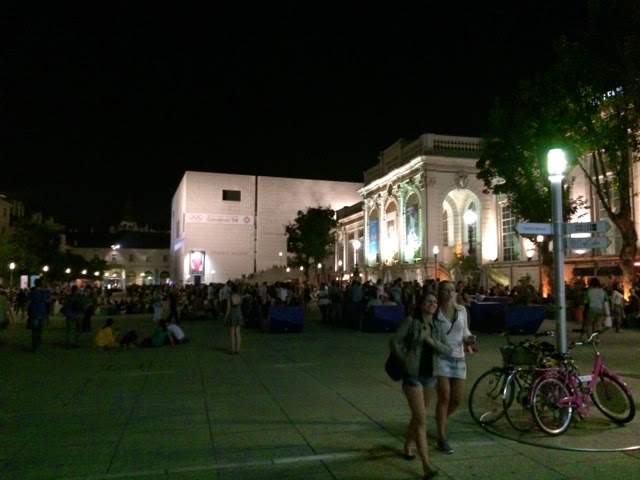
Most amazingly about Vienna's Museum Quarter is the shift in the atmosphere at night-time. It becomes one of the strangest and most interesting public spaces places I have ever seen. Starting around sunset, young and old Wieners come to the plazas to hang out. Many bring 24-packs (!) of beer and lounge all over the square. The lounging takes the form of  a lean on the wall, benches, street furniture, on the ground. Thousands of more people are hanging out in the cafés and bars of the museums even though the museums actually closed hours before.

The view of a reflecting pool in front of one of the museum-cafés:


MUMOK has free contemporary art films playing on a giant screen in one corner of the plaza. They give out wireless headphones to listen over the noise of the crowd: 


The most amazing thing about the Museum Quarter's night-life is this is for nothing. There are no festivals or youthful party bars nearby. People literally come here just to sit, chat, drink and have a good time. You'll never see the fences of beer gardens or patios, everyone simply walks around with their drink and their 24-pack (!) of beer and sit anywhere they want. You'll also see no alcohol-related problems and no police presence. It doesn't clear out until the early morning, approaching 3AM. 

Vienna is exemplary of how cities should build their public spaces. It might be one of the best in the world. Policies are put in place to encourage personal freedom and choice, not limiting freedom to use public space as if sitting in a plaza is a bad thing. No pouring out your drink if a policeman walks up, no anger or hostility of any kind. It is perfect.


I have more to show, but that's all for now - I haven't even described the public showing of famous Viennese opera films in front of the city hall; complete with food of all types and beer in the glass. An actual pint glass you can walk anywhere with in an enormous plaza of architectural marvels and thousands of people.

No plastic utensils here and high-priced food nonsense. Real food like the Kalbsbutter Schnitzel mit Erdäpfelpüree below (loosely translated as veal meatballs with a mashed potato purée):


Rathausplatz, where the films, food and beer is consumed:


In some parts of the world even indoor nightclubs and bars will refuse to give out glass-ware and utensils out of fear of violence, damage and broken glass.

Treat people like animals and they will act like them!

Vienna will do no such thing. It goes above and beyond other cities to prove that you are welcome here. Come and see it. Vienna is waiting for you.